Systems thinking as the key to 6G
Within the FNS program, Program Line 2 (PL2) plays a crucial role. At the beginning of 2026, we spoke with Fernando Kuipers, professor of Internet and Communication Systems at Delft University of Technology, who leads this program line and shares more about its ambitions, results, and looks ahead with us to phase two.
As the connecting link between hardware development and concrete applications, PL2 works on the software intelligence that will enable future 6G networks. “Networks have become enormously complex,” Fernando explains. “When something goes wrong, it is not always the result of a hack. It is often misconfigurations or unexpected interactions between systems. Everything somehow has to keep running smoothly, but it is becoming increasingly difficult for humans to manage it flawlessly.”
From complexity to manageability
The goal of PL2 is clear: developing tooling that allows operators and service providers to control networks at a higher level of abstraction. Instead of manually implementing countless configurations, they should be able to indicate what the network should do - after which algorithms and software automatically generate the correct settings. “We want operators to be able to specify, at a high level: this is what we want. The system should then automatically translate that into the right configurations and algorithms,” says Fernando. Artificial Intelligence (AI) plays an important role in this, but it is explicitly not the only technology involved. According to him, innovation lies not only in software or infrastructure, but particularly in their interaction. “There is no hardware without software. You need to think about co-creation: which intelligence do you embed at which place in the network? At the edge, where less computing power is available, you use different AI techniques than deep inside the network, for example in data centers.”
Systems thinking across the entire stack
PL2 distinguishes itself through what Fernando calls systems thinking: the realization that innovation does not take place in a single layer of the network, but in the interaction between hardware, software, and applications. “In all these layers there are algorithms. The challenge is to think across the entire stack and align innovations with each other.” This holistic approach has already produced several concrete results during the first two years. For example, Ericsson, Delft University of Technology and University of Amsterdam jointly developed a MANO tool (Management and Orchestration) for intelligently controlling networks.
PL2 has also strongly focused on digital twinning: creating digital replicas of networks to monitor and predict their behavior. With such a digital twin, new configurations or equipment can first be tested virtually. This reduces risks and accelerates innovation.
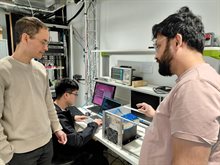
Other results from PL2 include developments in automatic configuration, AI-driven monitoring, architecture design, interfaces, security, DevOps, and root cause analysis - the process of identifying the true cause of network disruptions. “When something goes wrong, you often receive a flood of alerts,” Fernando explains. “Then you want to know: what is the real cause? Especially when AI makes decisions, you need to be able to explain why something happened.”
New business opportunities within 6G
A notable aspect of PL2 is that it brings together parties from different worlds: telecom, data centers, and internet infrastructure. This cross-fertilization leads to new insights and business opportunities. One example is AMS-IX, traditionally known as an internet exchange, which is exploring how its role could evolve within future 6G architectures with more edge computing and private networks. “Initially, parties all spoke their own language,” Fernando says. “But by working together, new ideas and opportunities emerge that you could not have imagined beforehand.”
Field Labs and value chains in phase two
While phase one mainly focused on research and individual demonstrations, phase two shifts the emphasis toward integration and application within broader value chains. Different demonstrations will be combined into larger, integrated demos running in field labs and the national testbed. “Now we are really moving toward proof of concept and integration,” says Fernando. “We want to demonstrate how our solutions contribute to economic value and the earning capacity of the Netherlands.”
The partner group within PL2 has recently expanded to include companies active in signaling, agentic AI, and satellite communications, including BroadForward, Future Connections, SES, IPKnowledge and Fortaegis. This also marks a step toward Non-Terrestrial Networks: communication via drones and satellites as a complement to terrestrial infrastructure.
Digital sovereignty as a driving force
For Fernando, there is also a broader context. He points to the growing importance of digital sovereignty and Europe’s dependence on large technology companies outside the continent.
“AI and quantum receive a lot of attention- and rightly so- but they still need something to run on,” he explains. “The underlying infrastructure is at least as important. With FNS we are developing vital technology according to European norms and values.” Within three years, he wants PL2 to be at the forefront, with integrated solutions that offer market opportunities and stand out internationally. “The unique aspect of FNS is that we collaborate across the entire chain within one large program. Other countries often distribute budgets across separate projects. Here we have the opportunity to truly co-create together.” With this integrated approach, Program Line 2 positions itself as the ‘glue’ within the 6G ecosystem: connecting, deepening, and focused on sustainable technological autonomy.