
Value Chains
Future Network Services is working on the technologies and applications that will enable the digital infrastructure of the future. At the heart of this are ten value chains in which businesses, knowledge institutions and research organisations collaborate on innovation and economic growth.
These value chains are aligned with the key 6G market developments and link technological development to practical applications. In this way, we ensure that new knowledge leads more quickly to new products, services and revenue models.
Value chains within Future Network Services
The ten value chains are divided into four horizontal value chains and six vertical value chains. The horizontal value chains form the technological building blocks of the 6G ecosystem. The vertical value chains focus on applications that create value for businesses, public authorities and citizens.
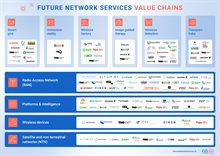
Vertical value chains
Vertical value chains focus on practical applications that add value for businesses, citizens and societal sectors.
Transport Hubs
With 3D coverage and real-time telemetry, we enable drone logistics. 6G connectivity ensures that all flight and location data are continuously monitored, allowing drones to transport goods safely, reliably, and cost-effectively.
Image-Guided Therapy
Medical applications in which 6G connectivity supports image-guided therapies. Real-time data exchange and high precision improve treatment outcomes.
Smart Grid
Smart energy grids in which supply and demand are balanced in real time to create a more efficient and sustainable energy system. 6G provides the highly reliable connection required for this.
Wireless Detection
Advanced detection and sensor technology for applications including traffic safety, mobility, and infrastructure monitoring. 6G technology enables accurate location tracking and object recognition.
Wireless Factory
Industry 4.0 with wireless connectivity. Reliable and secure 6G wireless networks form the foundation for smart production environments and support automation, robotics, and flexible production processes. By using Digital Twins, we can virtually monitor and optimize the factory
Immersive Reality
The next generation of interactive digital experiences with XR (extended reality), made possible by the connectivity and computing power of 6G. Applications for augmented reality, virtual reality, and mixed reality, targeting sectors such as industry, education, and healthcare, as well as new forms of interactive entertainment.
Horizontal value chains
The horizontal value chains form the technological foundation of the 6G ecosystem. They provide the hardware and software components needed to enable applications.
Radio Access Network (RAN)
Development of the materials, antennas, chips, and network components that form the foundation of 6G networks, with a focus on energy efficiency, improved coverage, and lower deployment costs.
Platforms & Intelligence
Smart cloud and AI platforms that automate network management and enable new digital services. The “brain” of the 6G network. Through advanced AI and efficient use of network capacity, they enable large-scale applications and new commercial opportunities.
Wireless Devices
New wireless devices that make optimal use of 6G and enable reliable, high-speed communication. These combine data transmission via light with advanced antenna technology. These innovations are not only applicable within 6G networks but are also finding their way into other sectors and applications.
Non-Terrestrial Networks (NTN)
Integration of satellite networks and mobile networks for global coverage, even in areas with limited reception. New antennas and technologies enable higher data speeds, while smart materials enhance reliability.