The FNS testbed as a showcase for 6G innovation
Within the FNS program, intensive work is underway on the networks of the future. One of the people playing a key role in this within the 6G National Testbed is Sander van der Zande, a senior consultant at TNO and lead for work package 4.1: the 6G National Testbed. His mission is clear: to create an environment in which companies, researchers and governments can jointly explore the possibilities of 6G — long before the technology officially reaches the market.
The interview demonstrates how the testbed is evolving into both a national experimentation environment and a visible showcase for innovation.
From 5G-plus to the first steps towards 6G
According to Sander, the work package consists of three main components. First of all, the team is building the technical infrastructure of the testbed. “We have deployed a mobile network that needs to evolve towards 6G,” he explains. The network currently starts from an advanced 5G environment but is gradually being expanded with new technologies and functionalities.
In addition, the testbed focuses on innovation. Companies can test applications that make use of future 6G functionalities, while researchers can experiment with prototypes from other FNS program lines in a realistic network environment. “For example, a new type of antenna or smart algorithms that could eventually become part of a 6G network.”
The third component revolves around knowledge sharing. Experiences and results from the fieldlabs must become accessible to a broader audience. Through the FNS website, the team aims to showcase use cases and inspire companies and organisations that are not yet actively involved with 6G.
Five fieldlabs across the Netherlands
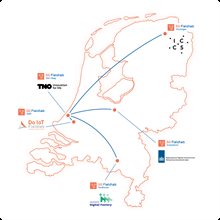
The 6G National Testbed consists of five fieldlabs spread across the Netherlands, including locations in Groningen, Delft, The Hague, Amersfoort and Eindhoven. According to Sander, this nationwide distribution was a deliberate choice. “In the past, initiatives like these often existed separately from one another. Now we are working in a far more coordinated and collaborative way.”
The fieldlabs play an important role in encouraging companies and organisations to start working with 6G applications. This is done through events, demonstrations and concrete examples of applications. More than one hundred letters of intent have already been collected from parties interested in developing a use case within the testbed.
From autonomous mowing robots to smart traffic systems
One of the first concrete applications is located in Groningen. Together with a company, researchers are investigating how autonomous mowing robots can navigate more effectively underneath solar panels, where GPS signals are less reliable. In the future, mobile networks may help provide highly accurate positioning for such machines.
A key technology in this development is sensing — a new functionality closely linked to 6G. Network antennas not only analyse communication signals but also use those signals to gather information about the surrounding environment. “These antennas can actually start seeing what is happening around them,” Sander explains. By combining this with AI and machine learning, entirely new insights can emerge, for example regarding traffic flows or drones operating in the airspace.
Sander sees this sensing capability as one of the most promising innovations of 6G. Smarter traffic lights, improved drone monitoring and more efficient mobility systems are, in his view, only the first examples of what will become possible. “I am very curious to see which new opportunities this will create and how society will benefit from them.”
Bridging the gap between research and practice
Although the testbed is now operational, Sander views the coming period primarily as a phase in which the connection between research and practical application must become stronger. During the first phase, the focus was mainly on building the foundation: the network had to function technically, fieldlabs had to be connected and collaborations needed to be established. Now, attention is shifting towards execution. “Phase two will be very much focused on execution: what are we actually going to do with it?” he says. This means running use cases, testing prototypes and demonstrating applications that can genuinely create societal impact.
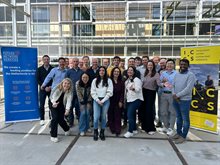
Collaboration plays a major role in this process. Within FNS, dozens of partners are working together, ranging from knowledge institutions to companies. Regular online meetings and physical gatherings ensure that knowledge is shared between the different fieldlabs. Sander describes a joint meeting at ICCS in Groningen as one of the most inspiring moments so far.
“The fact that everyone made that long journey to be there shows how much enthusiasm there is.”
A showcase for the future
According to Sander, the next important phase of the testbed is only just beginning: executing concrete use cases. “It is great that we have now established the foundation,” he says, “but the real highlights are still to come.” He is particularly looking forward to applications that clearly demonstrate what becomes possible thanks to 6G — things that simply could not be done before. “We want to develop exciting applications that truly benefit people — applications where you can say: wow, this was impossible in the past. The testbed will become an enormously important vehicle for showing what is happening within FNS,” he explains. “Research into antenna technology can often seem too technical for the outside world. But once you demonstrate it within a testbed, people can actually see what becomes possible.”
According to him, that visibility is essential, especially because 6G could have major societal impact. Reliable and intelligent networks will enable applications that are still impossible today — ranging from remote medical applications to smart mobility systems and autonomous infrastructures. “I am convinced that mobile networks provide enormous added value for society,” Sander concludes. “That already started with 5G, but with 6G we will go much further.”