Testbed lifts 6G from theory to practice
How do you prepare a country for a technology that does not exist yet? On 23 September, researchers, companies, regulators, and end users gathered at the RDI 6G Fieldlab in Amersfoort to show exactly that. The event, part of Digitalization Week, made clear that the National 6G Testbed is moving from theory into practice.
The overarching message was clear: 6G innovation is no longer just about technology development; it is about building a collaborative ecosystem that accelerates the path from experimentation to real-world deployment.
One 6G Testbed, no fragmentation
Ties Dammers (RDI) opened the afternoon by looking ahead to 2030, with a clear call to action: start experimenting with future network technologies now, through the Dutch Fieldlabs, because practical experience today speeds up readiness for 6G applications tomorrow.
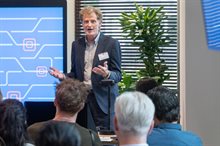
Lenneke de Voogd (TU Delft, Lead FNS Program Line 5) picked up that call and raised it a level. Europe increasingly recognizes digital infrastructure as a matter of technological sovereignty, and FNS plays a dual role in that: as an innovation platform, and as a step toward greater European digital autonomy. Turning technological innovation into practical value, that is what needs to happen now, she argued, and the National 6G Testbed ecosystem is how.
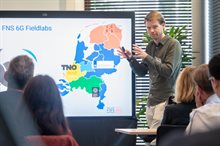
Floris Drijver (TNO, Technical Lead National 6G Testbed) brought that vision back to the technology itself, and to a hard lesson from the 5G era: don't let it dissolve again into scattered, fragmented initiatives. Instead, FNS is building one unified National 6G Testbed, connecting multiple 6G Fieldlabs through a shared, open blueprint for the infrastructure. Anyone who wants in can now do so through the new FNS Kiosk, an online portal to the testbed and its services. Each fieldlab brings its own expertise, from drone applications in Groningen to wireless manufacturing in Eindhoven, with one message from Drijver to the room: don't wait any longer to start experimenting.
Get the business moving
A testbed is nice, but it only pays off once companies actually move forward with it. Erik van de Pieterman (OostNL) showed exactly how, using Sabratha, a University of Twente spin-off developing chips for future 6G infrastructure, as the example. FNS supports companies in three ways: access to testing facilities, connections to the FNS partner network, and support in finding funding. SMEs not yet involved in FNS can join too, starting with an intake that connects them to the right expertise.
And without rules? Nobody gets anywhere. Peter Disseldorp walked the room through the regulatory framework: which licensing models apply to experimenting with frequencies, ranging from site-specific to experiment-specific licenses. One concrete example is the widely discussed 600 MHz test mast in Delft. Without that regulatory foundation, he stressed, large-scale testing of future network technologies simply would not be possible.
The demo: feeling what a robot feels
For many attendees, the highlight of the afternoon was a live teleoperation demonstration, presented by Wouter Bakker (RDI) and Kees Kroep (TU Delft). An operator remotely controlled a robot, with active force feedback: not just seeing what the robot does, but also feeling what it feels. The connection ran across the RDI Fieldlab in Amersfoort, the Do IoT Fieldlab in Delft, and the FNS Core Testbed Network at TNO in The Hague.

Applications like this need more than higher speed alone: ultra-low latency and highly reliable communication, exactly the strengths 6G is expected to deliver. That opens up work in places where you would rather not send people. Think of offshore wind farms, chemical plants, or a nuclear reactor.
Once a robot's actions are digitized, more becomes possible than remote control alone. The speakers compared it to adding layers in Photoshop: AI-assisted decision support, digital overlays for situational awareness, sensor fusion from multiple data sources, automated safety features, and predictive maintenance, all on top of the same connection. According to Kees Kroep, the first commercially viable use case is likely to be maintenance and inspection in difficult or hazardous environments.
What's next
The event showed that the Netherlands is choosing a coordinated approach to 6G, not fragmented initiatives. Through the FNS program, connected 6G Fieldlabs, a shared National 6G Testbed, business support, and a clear regulatory framework, an ecosystem is taking shape in which organizations can move beyond research alone, to actually develop, test, and commercialize 6G applications.
Accelerating Innovation with 6G was organized by the National 6G Testbed, together with Digital Holland, NL digital, and the Delft 6G Fieldlab, as part of Digitalization Week.
Curious what the Testbed could mean for your organization? On this page of the FNS website you will find the contact details for the individual 6G Fieldlabs.