
FNS partners focus on connecting: together from 6G research to impact
How do you turn 6G research into something the market wants to use? That question took center stage at the biannual FNS Partner Event on 8 October 2026. Some 180 participants gathered at the Munthuys in Utrecht, where silver and gold coins were once minted. Their conclusion: the real value of 6G lies in collaboration. After all, it is a network.
From program lines to value chains
Program Director Peter Rake explained how FNS Phase 2 is organised. Research and innovation take place in five program lines. What is new is that value chains decide where those results go.
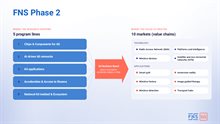
There are ten markets. Each is led by a member of the 6G Business Board, with representatives from KPN, NXP, Nokia, Ericsson, TNO, and others. The board can accelerate, adjust, or stop activities, and guides startups on their way to investors. Rake's message: research must translate into growth, and collaboration between partners is key.
Speed and investment
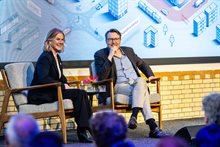
Constantijn van Oranje of Techleap was once skeptical about FNS. On stage with Lenneke de Voogd, he admitted that the program had surprised him: ‘You really managed to engage a much, much bigger group, and also became very pragmatic.’ At the same time, he challenged the partners. The competition is in China, Silicon Valley, and Korea, where the pace is high. And startups need more than subsidies: they need investors who come on board early and stay for the long term.
The ambition is high. In a poll, the partners estimated the combined added value of their 6G work at billions of euros by 2040. To make that happen, FNS Phase 2 also includes a new program line for acceleration and access to finance.
The strength of FNS lies in its network. More than 70 partners, 16 of them new in Phase 2, and five national 6G testbeds together form a marketplace where supply meets demand. Łukasz Bromirski of IS-Wireless asked the room which FNS result will be running in a real network by 2028. Only a limited number of hands went up, which was exactly his point. His call: find each other. One partner has a technology, another a network, customer, or application, and together you get further.
‘FNS Phase 2 is about moving from world-class research to world-class impact, and that requires us to connect.’
Paul Wijngaard, Alliance Director FNS
Protect values by design
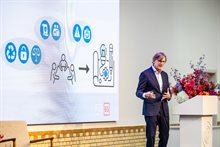
Technology is never neutral, Jeroen van den Hoven explained. He is professor of ethics and technology at TU Delft and a member of the FNS Ethics Committee. The US, China, and Russia are all trying to influence 6G standards. Whoever sets the standard also decides which values it carries. Europe therefore needs a seat at the table, with technology that reflects European values and legislation.
According to Van den Hoven, privacy, security, and reliability must be built in from the start, not added later. You do that by translating values into concrete design requirements. An example from FNS: a network can replace a phone's permanent identification number with one that changes frequently. Users stay protected, while law enforcement can still act through legal procedures. ‘If we don't, others may do it for us,’ he warned.
This is a recurring topic within FNS. A dedicated work package studies how 6G fits within European and Dutch rules, such as the AI Act and privacy legislation, and provides input for new policy.
Example: detecting drones
Drone detection showed how technology, policy, and collaboration come together. With integrated sensing and communication (ISAC), the mobile network also becomes a sensor. It can, for example, detect drones in the air. Since April, Europe has been studying which spectrum is suitable, starting with the 3.5 GHz band. A first draft report is expected in mid-2027.
The ISAC session, with many questions from the audience, showed how much remains unanswered. Who pays for drone detection? And is it a commercial service for operators or a national task? One possible solution: operators provide detection as a service, and the government decides what to do with the information.
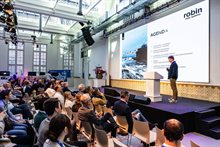
Vivien Croes, CTO of Robin Radar Systems, took the audience to 2030. His company builds radars that detect birds and drones. . Croes envisions fixed corridors for drones above cities. That requires accurate tracking of drones, birds, and weather, and controlling the drones through the same network. His lesson echoed Van Oranje's: ‘Capturing an emerging market requires agility and speed.’
Next steps
FNS calls on partners to join the value chain meetings, seek out international collaboration, and make their results visible. In the first quarter of 2027, RVO will also launch Open Calls with a total of 34 million euros in 6G related subsidies, including funding for SME feasibility studies and national and European collaboration projects.