FNS Learning Communities and Fieldlabs explore Europe’s 6G agenda in Brussels
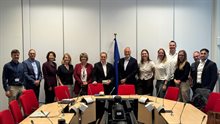
What does Europe need to stay ahead in 6G? Strong technology, but also people who know how to develop, test, and apply it. To learn what that means in practice, the FNS Human Capital team travelled to Brussels on 16 and 17 September, representing the 6G Learning Communities and 6G Fieldlabs.
“6G is not only about technology. It is also about people, skills, and talent. And if we want Europe to remain at the forefront of 6G, we need to connect our national strengths and learn from each other.”
Lenneke de Voogd, Program Lead National 6G Testbed & Ecosystem
European talent
On the first day, the team met Francesca Maltauro of the European Commission. She is Deputy Head of Unit for Digital Education, STEM, and AI Literacy at the Directorate-General for Education, Youth, Sport and Culture (DG EAC). With her, the team discussed digital education, STEM and AI literacy. This was followed by a meeting with the Permanent Representation of the Netherlands to the EU about the Union of Skills, with a focus on basic skills, digital skills and STEM education policy. The Netherlands House for Education and Research (Neth-ER) then described Europe’s position in the global race for emerging technologies and explained why talent is key to Europe’s future competitiveness.
Mutual interest
On the second day, the team met with the 6G Smart Networks and Services Industry Association (6G-IA). This was followed by a joint meeting with the Smart Networks and Services Joint Undertaking (SNS JU) and the Future Connectivity unit of DG CONNECT. These meetings revealed strong interest in how FNS connects the National 6G Testbed and regional 6G Fieldlabs with its Human Capital Agenda and Learning Communities.
Within FNS, large and small companies work with researchers, students, and educators on the technology of tomorrow. The European representatives will use this approach, along with other national 6G initiatives, as input for future European 6G programmes and SNS JU calls.
In turn, the FNS team explored upcoming European opportunities and how European programmes can strengthen national activities. The conversations showed the value of connecting national 6G initiatives by sharing experience and infrastructure, and by linking technology development, experimentation, skills, and adoption more closely.
Next steps
The team returned with new insights, valuable European contacts, and a clear set of follow-up actions to further strengthen the ties between FNS and the European 6G ecosystem.
Lenneke de Voogd sums up the Brussels visit as follows: “By connecting testbeds, fieldlabs, education, and industry across national borders, we accelerate both innovation and adoption. That is how European collaboration can make the difference.”